|
  |
                  |
 |
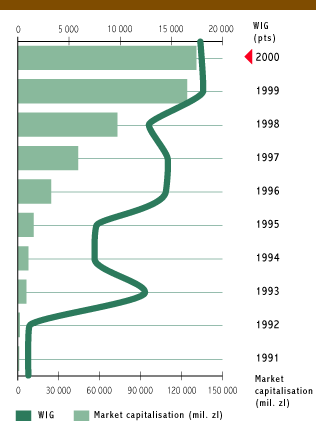
The year on the Exchange '[...] thanks to a good year's end, the WSE ranked unexpectedly well against the backdrop of mature stock markets, for which 2000 was one of the worst in the past decade. The Dow Jones lost nearly 6 percent (its worst showing since 1981), as did the German Xetra DAX. London's FTSE-100 dove over 10%, while the new-economy barometer - the Nasdaq - plummeted nearly 40%. This was a record fall since the market was created in 1971,' wrote Gazeta Wyborcza (a Polish daily), summing up 2000 on the WSE and global markets. As on other markets, Polish investors had no cause for satisfaction in 2000. The main index, the WIG, lost 1.3%; the blue-chip index, the WIG20, chalked up a mediocre 1.5% rise. The MIDWIG, the index for medium-size companies listed on the WSE, lost 9.9%; the NIF (National Investment Funds index) dropped 2.1%. In contrast, the WIRR (the parallel market index) shot up 31.8%, but the record gain for 2000 belongs to the TechWIG, the index for the SiTech segment (innovative technologies), which skyrocketed 45.7%. The bear market in 2000 should not have come as a surprise, since economic trends in Poland were working against investors. High interest rates, raised even higher in 2000 by the Monetary Policy Council, were more of an incentive to invest in bank deposits than in stocks. Listed companies posted weaker profit growth rates in 2000 than in previous years. Public offerings were not able to mobilise investors. There were no large privatisations to attract new investors to the market. The first quarter was the best period for investors. This is when both the US and Western European markets were bullish, driven by tech stocks. Successive months, however, brought steady declines in the share prices of most main-market companies, although it should be stressed that the scale of the reaction in Poland was much smaller than on mature markets. Thanks to the Internet stock boom in the first months of 2000, turnover on the WSE rose significantly, reaching an all-time high. Turnover for the year came to 245 billion zloty, - 138 % more than in 1999, when a turnover of 106.6 billion zloty was recorded. Although this growth was driven by equities, futures and warrants also played a meaningful role. The year 2000 was also distinguished by further stabilisation of ownership changes in listed companies; most of them now have strategic investors. After the wave of bids for stocks in the previous year, there were only 27 bids in 2000.
|
|

| ||||||||||||